Altair WinProp is the most comprehensive toolset in the field of radio wave propagation and wireless network planning. Covering wireless links from satellite to ground, from suburban to urban environments, and indoors, WinProp’s innovative radio propagation models can deliver accurate analysis in a very short computation time.
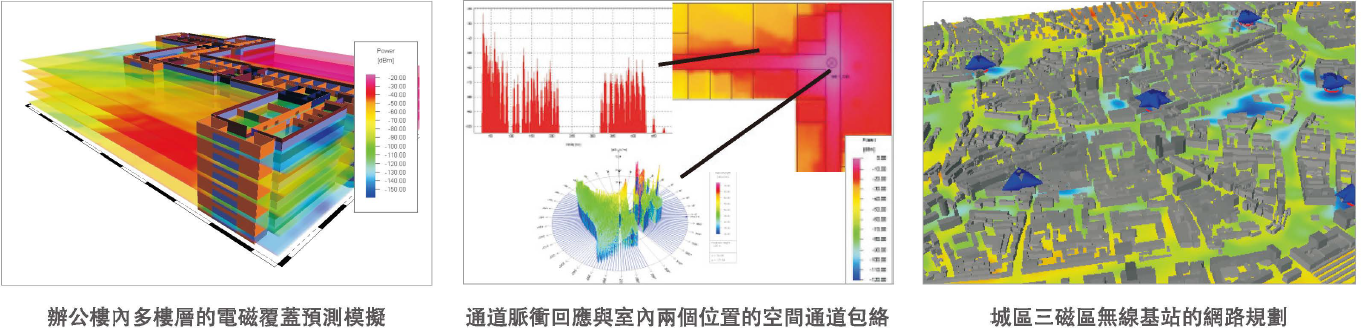
【 Product Highlights 】
-
Innovative empirical and ray-optics/deterministic radio propagation models that achieve accurate results with short computation times
-
Supports a wide range of scenarios and rich map data formats, especially hybrid-scenario analysis
-
Wireless network planning modules support a broad set of wireless communication standards (cellular including 3G / 4G / 5G, wireless LAN such as W-LAN, etc.)
-
A flexible Altair WinProp application programming interface (API) makes it easy to integrate the full propagation models and network planning capabilities into other software tools
Altair WinProp provides a rich set of radio propagation models and is a powerful toolbox for multi-scenario propagation and efficient network planning.
WinProp includes the following dedicated modules:
-
ProMan – radio propagation and network planning analysis
-
WallMan – graphical editor for vector building databases
-
AMan – graphical editor for antenna radiation patterns
-
CoMan – simulator for connectivity of sensors and networks
-
TuMan – geometry editor for tunnels and stadiums
【 Scenarios and Applications 】
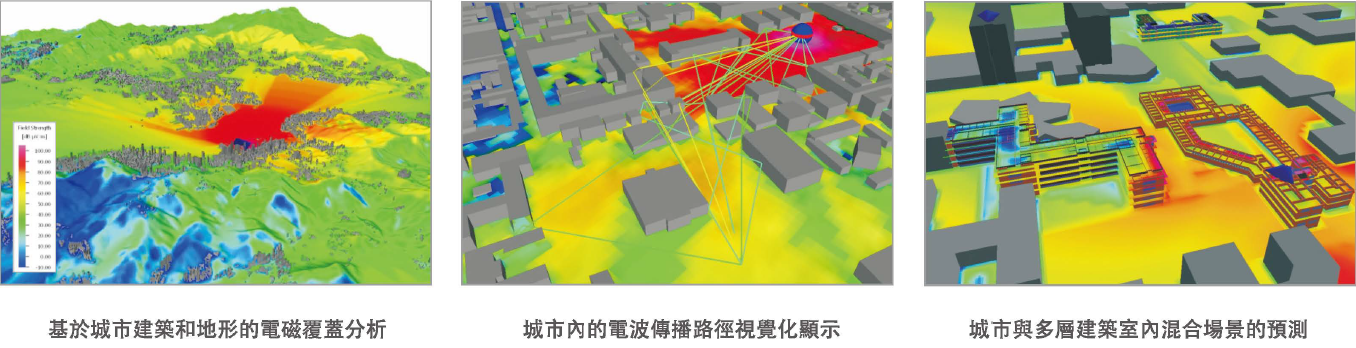
WinProp’s high-accuracy, fast empirical and deterministic propagation models are applicable to many scenarios:
-
Rural and open areas
-
Urban and suburban environments
-
Indoor and campus scenarios
-
Tunnels and underground rail systems
-
Transportation and time-varying scenarios
-
GEO and LEO satellite communications
WinProp supports any type of transmitter, including cellular base stations, broadcast transmitters, satellites, repeaters, and leaky feeder cables.
【 Databases 】
Depending on the scenario, simulation predictions are based on terrain (raster), morphology (raster – with/without height and land-cover), urban buildings (raster or vector), or 3D planar objects/walls (vector) databases.
Different types of databases can be used simultaneously and converted between each other during propagation prediction. Graphic editors, CAD tools, and various format converters support all database types.
【 Propagation Models 】
.......The powerful WinProp propagation engine includes empirical and semi-empirical models (calibrated with measurement data), rigorous 3D ray-tracing models, and the unique Dominant Path Model (DPM). In addition to path loss, WinProp also computes delay spread, angular spread, line-of-sight / non-line-of-sight conditions (LOS / NLOS), directional channel impulse responses, angular profiles, and propagation paths.
【 Altair WinProp API and Engine 】
.......The WinProp application programming interface (API) is available for both the propagation engine and network planning modules. The API is very easy to call, allowing users to integrate the propagation models (or network planning engine) into in-house codes or third-party software.
【 Air Interfaces and Applications 】
WinProp includes many predefined air interfaces and application templates:
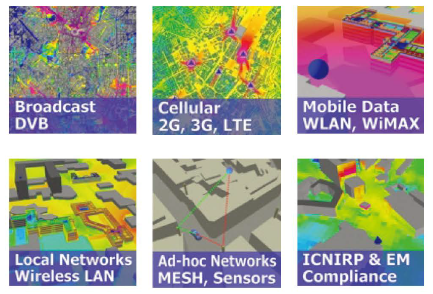
Users can also define new propagation scenarios as needed. In addition to network planning, WinProp can be used for electromagnetic exposure analysis based on ICNIRP and EMC regulations.
【 Computation and Simulation 】
Depending on the application requirements, WinProp provides static, Monte Carlo, and dynamic network simulators. WinProp supports network coverage planning, capacity analysis, and network simulation (algorithm performance, latency characteristics, etc.). Users can define base station locations and blocking conditions for circuit-switched and packet-switched services (including hotspot statistics, mobile stations, etc.).
【 Base Station Coverage 】
WinProp allows you to define different transmission modes (bandwidth, modulation and coding scheme MCS, data rate, signal-to-noise-and-interference ratio, signal thresholds, transmit power). Coverage maps (cell layout, serving cell, active set, channel quality, uplink and downlink received power, SINR) are calculated separately according to the selected transmission modes. Link adaptation is determined by the channel quality computed from the propagation model. For each location in the coverage area, the maximum received power and maximum achievable data rate can be estimated.
【 Capacity 】
Based on coverage analysis and traffic assumptions, WinProp computes the capacity of different RF links and cells in the network (throughput, maximum data rate, packet delay, quality of service). This makes it easy to predict cell capacity limits and overloaded cells, and to perform network optimization to achieve high capacity and high throughput. Complex deterministic propagation models accurately capture the improvements in communication capacity enabled by MIMO and beamforming. The characteristics of arbitrary antennas (linear polarization, circular polarization) and their impact on the wireless channel in the propagation analysis are fully taken into account in the network planning.
【 Altair Feko™ and WinProp Integration 】
Electromagnetic simulation can be used for antenna design and to compute antenna radiation characteristics, obtaining 3D radiation patterns. Feko and its comprehensive set of solvers are ideally suited for these tasks, and the resulting 3D far-field patterns can be superimposed into WinProp’s radio propagation models for wireless channel analysis.
WinProp provides an interface for importing and processing 3D antenna patterns exported from Feko. To accelerate simulations in complex scenarios, complicated targets such as vehicles can be replaced by their radar cross section (bistatic RCS computed in Feko).
Richin Tech is the "expert in CAE and AI data analytics", and we have completed many successful case studies.
▶ Contact us now to get more information.
▶ Subscribe to the Richin YouTube channel to explore more about CAE and data analytics.



