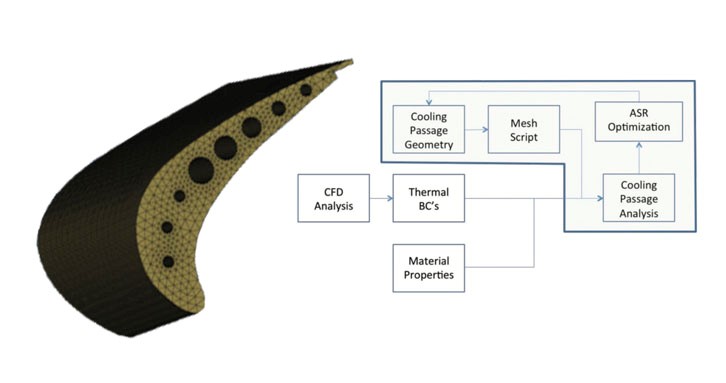
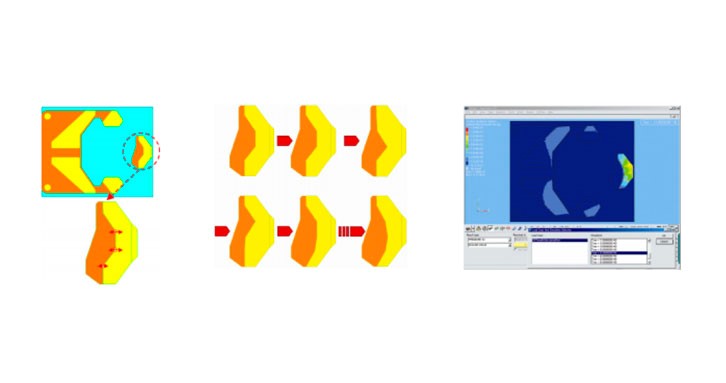
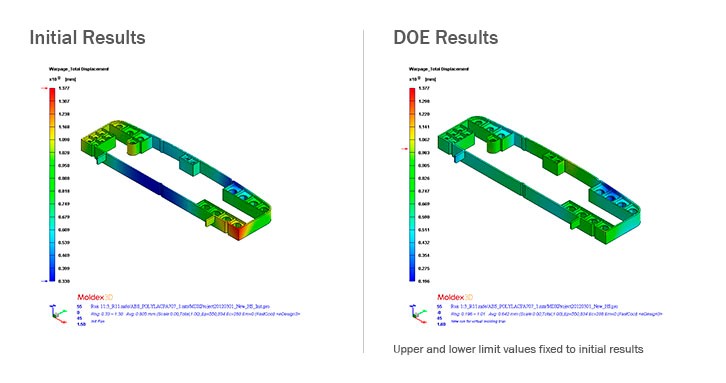
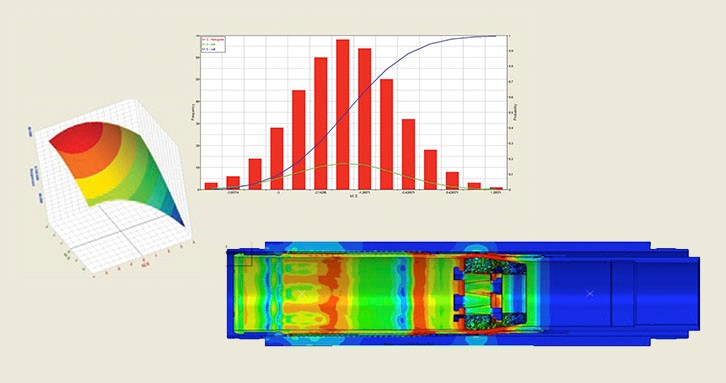
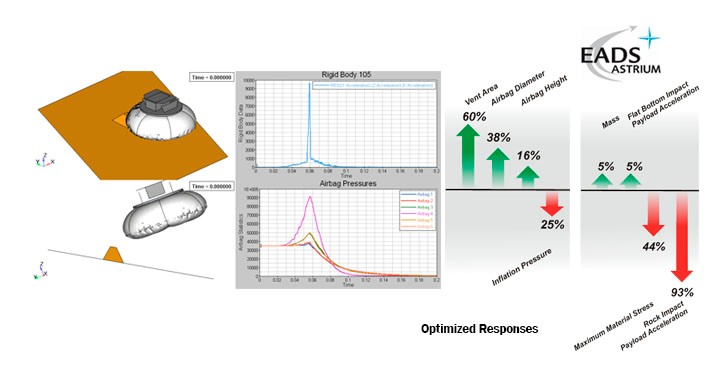
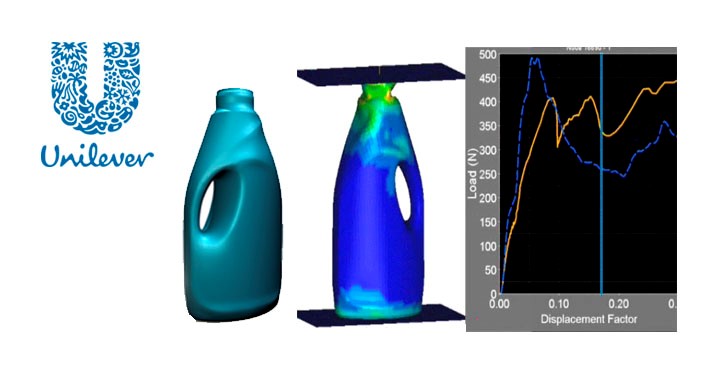
HyperStudy is an optimization design software that assists engineers and designers in making decisions. It can help you find the best design solutions. Guided by HyperStudy, users can understand data trends, investigate the pros and cons of designs, identify the sensitivity of design parameters to results (DOE), and optimize design performance and reliability.
HyperStudy helps users explore, understand, and improve their designs through Design of Experiments, response surface fitting, optimization, and other methods. With HyperStudy’s advanced post-processing and data extraction capabilities, study results can be analyzed and interpreted with ease. HyperStudy not only provides an intuitive user interface, it also integrates seamlessly with HyperWorks for direct model parameterization, and supports reading CAE results, greatly simplifying study setup.
【 Advantages 】
Improve design performance and quality
HyperStudy features state-of-the-art optimization, Design of Experiments, and stochastic analysis methods, enabling fast evaluations and improving design performance and quality.
Perform comparative studies
HyperStudy’s fitting capabilities allow users to build response surface models. These efficient surrogate models can be used to perform trade-off and comparative studies, and can also be exported as spreadsheets for use by field engineers.
Reduce development time and cost
HyperStudy helps engineers reduce trial-and-error iterations, thereby shortening design development and test time.
Increase productivity with an easy-to-use environment
HyperStudy’s step-by-step workflow guides users through building and running design studies. Its open architecture allows easy integration with third-party solvers.
Powerful dataset analysis capabilities
With a complete set of post-processing and data extraction methods, engineers’ work is simplified and they are better supported in analyzing and understanding large simulation datasets.
Improve simulation correlation
HyperStudy’s optimization capabilities can be used to improve correlation between analysis models and test results, or between different models.
【 Features 】
Design of Experiments
Design of Experiments (DOE) methods in HyperStudy include:
-
Full factorial
-
Plackett-Burman
-
Central composite design
-
Hammersley
|
|
The study matrix can be composed of controllable or uncontrollable, continuous or discrete variables. DOE studies can be conducted using high-fidelity simulations or fitted models.
Response Surface Method (Fit)
Available response surface fitting methods include:
-
Least squares method
-
HyperKriging
|
|
Response surfaces can be used to perform trade-off studies, DOE, optimization, and stochastic studies.
Optimization
.......HyperStudy provides a comprehensive set of optimization methods to solve different types of design problems, including multi-objective and reliability/robustness-based design optimization. The methods include:
-
Adaptive Response Surface Method (ARSM)
-
Sequential quadratic programming
-
Genetic algorithm
-
Sequential Optimization and Reliability Assessment (SORA)
-
Single-loop method
|
-
Global Response Surface Method (GRSM)
-
Multi-objective genetic algorithm
-
SORA based on ARSM
-
User-defined optimization algorithms
|
Optimization studies can be executed using high-fidelity simulations or fitted models. In addition, HyperStudy provides APIs to integrate external optimization algorithms.
Stochastic
Stochastic methods in HyperStudy help engineers evaluate the reliability and robustness of designs and provide qualitative guidance for improvement and optimization based on these evaluations.
HyperStudy’s sampling methods include:
-
Simple random sampling
-
Hammersley
|
|
Stochastic studies can be executed using high-fidelity simulations or fitted models.
Post-processing and data extraction
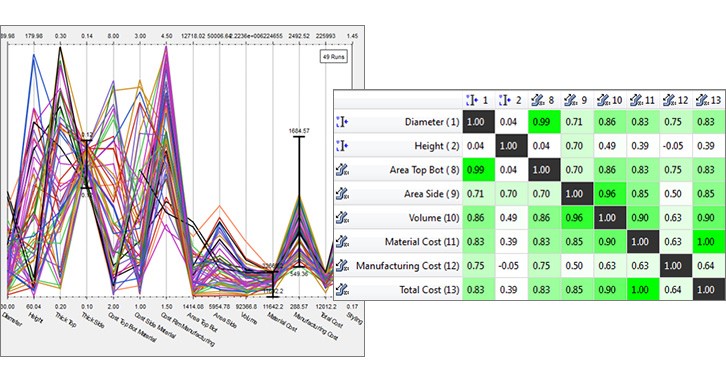
HyperStudy provides diverse post-processing and data extraction functions that help engineers deepen their understanding of designs. This greatly simplifies the work of studying, organizing, and analyzing results. Study results can be post-processed and presented as statistical data, correlation matrices, scatter plots, box plots, interaction plots, bar charts, and parallel coordinate plots. HyperStudy can also guide users to choose suitable post-processing methods based on design objectives.
【 New Features in HyperStudy 】
HyperStudy 2023 delivers outstanding new features and enhancements, including two new model types, a customizable user interface, innovative design exploration methods, and powerful post-processing.
In summary, this release provides more efficient and more effective design exploration methods and offers improved usability for design engineers, analysts, domain experts, and non-experts alike.
HyperStudy includes two new model type libraries
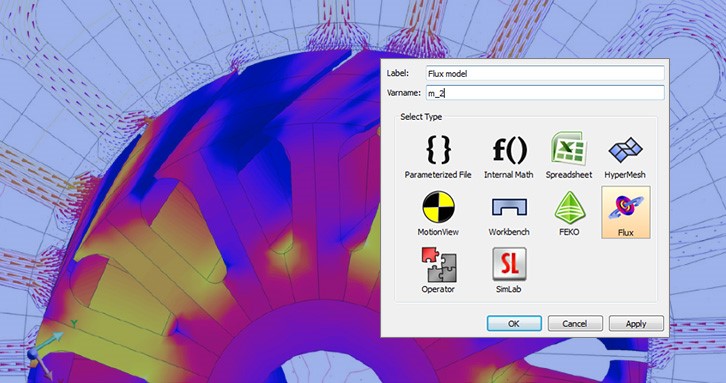
Flux models enable seamless integration between HyperStudy and Flux (the low-frequency electromagnetic solver within Altair HyperWorks). Input variables and output responses can be automatically computed. Operator models help modularize complex workflows and reduce the need for scripting.
Extended feature setup capabilities
HyperStudy can now handle categorical variables. These categorical variables take their values from a list of options that cannot be ordered by numerical comparison. Material selection and part switching are common use cases for categorical variables. Constraints involving functions of input variables can be defined directly in the study setup. Designs that violate these constraints are excluded from the run matrix. By eliminating such designs before method evaluation, sampling efficiency is increased and overall run time is reduced.
Method improvements
-
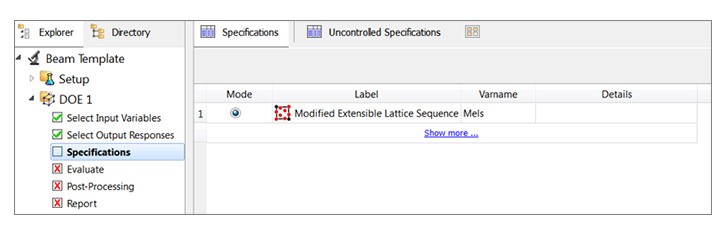
Modified Extensible Lattice Sequence (MELS) is an innovative space-filling method for DOE and stochastic studies. To improve fitting accuracy, multiple runs are often required. By adding runs in the regions of the design space that are least explored, the scalability of the MELS method intelligently addresses this need.
-
D-Optimal is a classical space-filling DOE used to sample data for least-squares regression modeling. Fractional factorial designs are selected based on the required resolution. Resolution measures the ability to separate main effects from interactions. Understanding the resolution of a fractional factorial DOE helps interpret the efficiency and accuracy of DOE results.
Resolution options in fractional factorial DOE
Post-processing
-
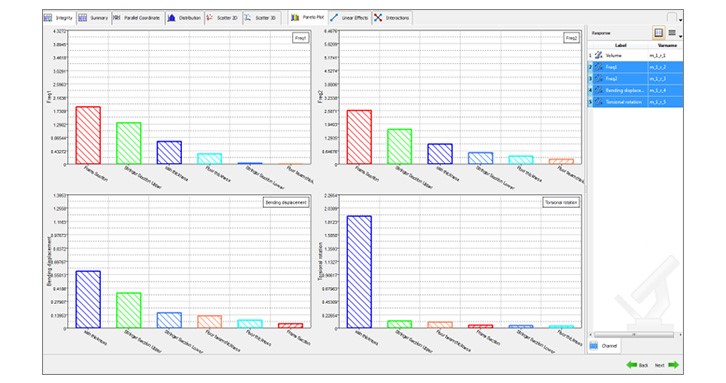
Pareto charts have been added for DOE post-processing. Pareto charts present, in bar-chart form, the effect of variables on responses ordered by importance.
-
These clear, easy-to-understand plots are an effective tool for presenting DOE results.
-
Parallel coordinates and correlation plots have been enhanced with filtering options, making it easier to identify important relationships.
-
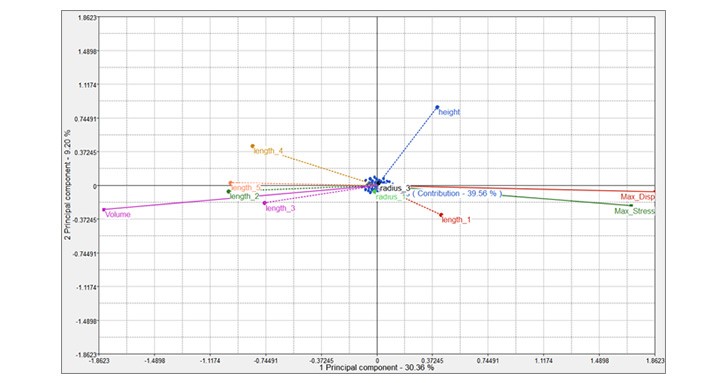
A ranking plot has been added to the General Post-Processing tab. Ranking plots present biplots from principal component analysis and can be used to identify relationships between variables and responses, especially in high-dimensional problems.
For each method-specific step, the method-oriented guidance has been updated. A subset of all available methods is displayed by default, and the full list can be expanded as needed. This change aligns the interface with HyperStudy’s recommended best practices.
General usability
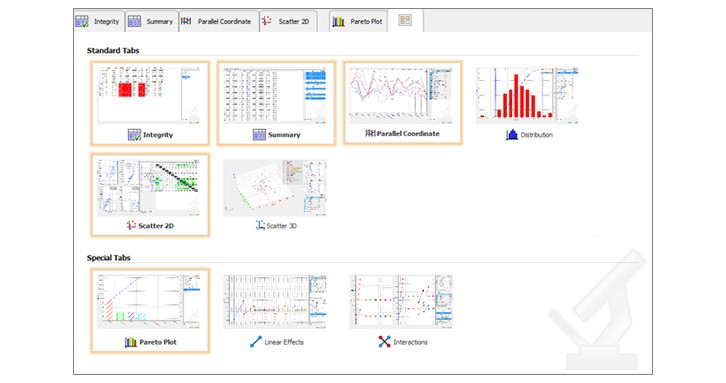
The user environment can be customized to show only a subset of the available tabs. Individual tabs can be turned on or off so that the interface displays only the tabs that are used frequently.
Richin Tech is the "expert in CAE and AI data analytics", and we have completed many successful case studies.
▶ Contact us now to get more information.
▶ Subscribe to the Richin YouTube channel to explore more about CAE and data analytics.