Fast Aerodynamic Simulation
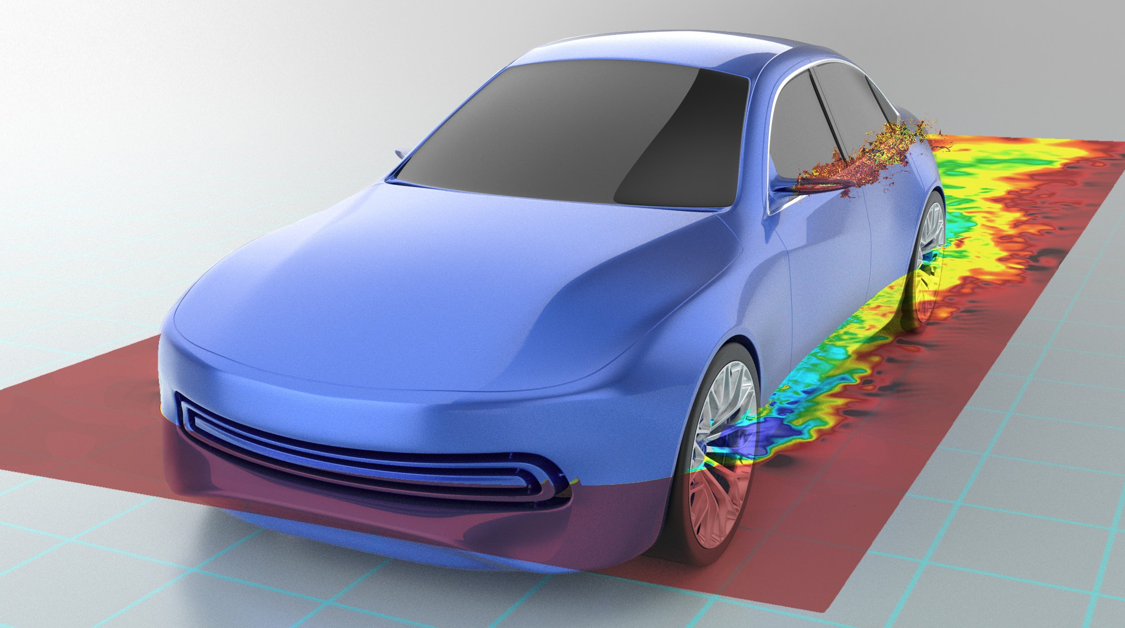
Altair ultraFluidX is a simulation tool for rapidly predicting the aerodynamic characteristics of passenger and commercial vehicles, and it can also be used to evaluate environmental aerodynamics around buildings. This cutting-edge technology, based on the lattice Boltzmann method (LBM) and further optimized for GPUs, delivers unmatched performance.
【 Product Highlights 】
-
Lattice Boltzmann method (LBM) combined with LES turbulence modeling
-
Integrated, powerful volume meshing for rapid design changes
-
Efficient GPU acceleration to support transient analysis
-
A solution purpose-built for external aerodynamics
【 Advantages 】
With ultraFluidX, high-fidelity transient aerodynamic simulations can be performed on a single server.
Fast and easy simulation setup
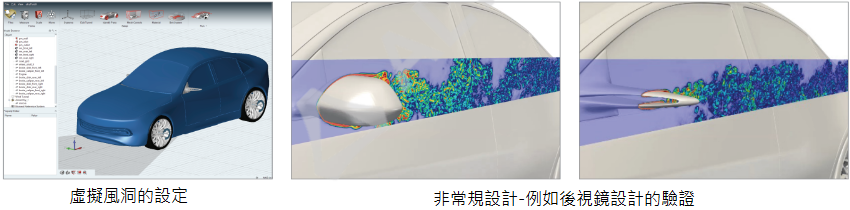
Embedded in the Altair Simulation platform as Altair Virtual Wind Tunnel, setting up an external aerodynamic simulation becomes very convenient. For different vehicle types, templates can be created quickly, the workflow is clear, and the risk of errors is greatly reduced.
Significantly reduced pre-processing effort
Thanks to the “drag-and-drop” nature of the lattice Boltzmann method, the solver has low sensitivity to surface mesh quality, allows interference and penetration between components, and supports fully automated mesh generation. All this makes component replacement even easier than in a physical wind tunnel, and makes it feasible to evaluate hundreds of design variants to meet regulatory requirements.
Shorter turnaround time: results overnight
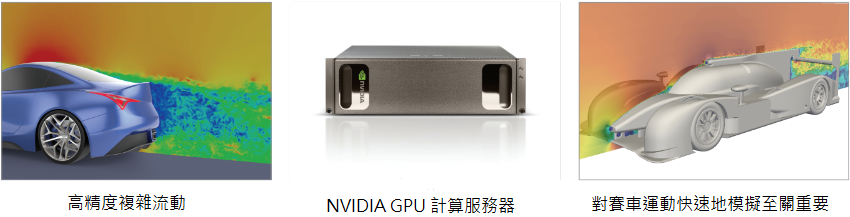
The lattice Boltzmann method is perfectly suited for massively parallel computing architectures such as GPUs, enabling unprecedented turnaround times. With advanced GPU-optimized algorithms, you can obtain results from high-resolution transient LES aerodynamic simulations in a single overnight run on one server.
Significant cost savings
Compared with GPU-based ultraFluidX, traditional simulation approaches require thousands of CPU cores to achieve a similar turnaround time. The GPU-based solution not only improves computational efficiency but also reduces hardware and energy costs.
Transient simulations
Bluff-body aerodynamics, especially automotive aerodynamics, are inherently highly unsteady physical phenomena. With ultraFluidX, high-resolution transient LES simulations can be performed in practical time, so you no longer need to sacrifice transient physics and resort to steady-state analyses.
【 Industrial Applications 】
ultraFluidX is tailored for high-resolution external aerodynamics, with applications including:
Ground vehicles under various operating conditions
Simulate vehicle aerodynamic forces and moments (e.g., drag, lift, roll moment, pitch moment, yaw moment) and study the three-dimensional transient flow field to understand aerodynamic characteristics. CFD analysis targets include minimizing drag to reduce fuel consumption and balancing front/rear lift and lateral forces to improve driving stability.
Fan aeroacoustics
The fan rotation region is modeled using an overset mesh, with the blade geometry undergoing true rotation. Virtual microphone locations are positioned in advance of the simulation to record pressure signals.
【 Features 】
ultraFluidX provides faster pre-processing, advanced GPU technology, minimal simulation times, and intuitive post-processing of simulation results.
Model preparation
We recommend using HyperWorks pre-processing tools to clean and simplify the original CAD model. Model setup is completed in Altair Virtual Wind Tunnel, including: moving-ground systems, boundary-layer suction, porous media, wheel rotation, lattice refinement, leakage detection, solver parameters, and more. The entire workflow is highly customizable, can be saved as a template, and can be executed in batch, significantly reducing manual effort.
GPU computing
Compared with more cumbersome CPU-based approaches, GPU computing offers significant performance benefits and reduced power consumption. The GPU revolution in scientific and engineering computing is rapidly unfolding, and ultraFluidX is one of the pioneering commercial software products that harness this technology, delivering substantial gains in product development speed.
Result analysis
Transient aerodynamic simulations typically generate massive amounts of result data that must be post-processed to support product development and optimization. Altair’s powerful client-server parallel architecture supports interactive CFD post-processing. Even for large datasets, it is easy to automatically generate reports and create customized post-processing templates.
Hardware requirements
The Altair CFD team recommends NVIDIA A100 NVLink or V100 GPUs, which are mature accelerator cards and the core of scientific computing. ultraFluidX has been tested on these platforms.
Richin Tech is the "expert in CAE and AI data analytics", and we have completed many successful case studies.
▶ Contact us now to get more information.
▶ Subscribe to the Richin YouTube channel to explore more about CAE and data analytics.



