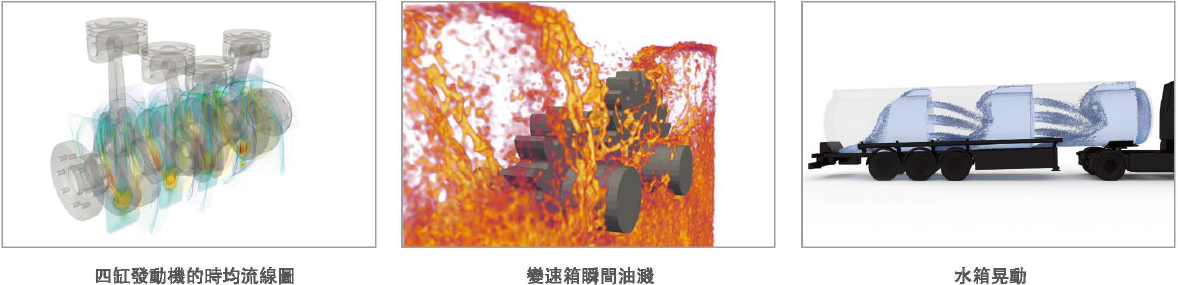
.......Altair nanoFluidX is a smoothed particle hydrodynamics (SPH) fluid-dynamics simulation tool for predicting flows with complex mechanical motion in complex geometries. It can be used to predict lubrication in drivelines with rotating shafts and gears and to analyze the forces and torques on each component in the system, while accounting for rotating components such as gears, oil splashing and fling-off between lubricant and air, as well as heat transfer and temperature distribution. At the same time, Altair nanoFluidX uses smoothed particle hydrodynamics (SPH). Compared with traditional CFD, SPH provides a much faster description of free-surface flows, and using the GPU as the core solver gives Altair nanoFluidX significantly better computational efficiency.
Superior acceleration performance through GPU computing
Ideally suited to complex driveline applications, including gearboxes, crank mechanisms, and more
【 Advantages 】
nanoFluidX is based on a weakly compressible SPH method and includes many unique features that improve computational accuracy, making it a distinctive particle-based solution on the market.
From the ground up, the solver is designed to run on graphics processing units (GPUs), which makes computations extremely fast. It can be used to predict oiling in powertrain systems with rotating shafts/gears, analyze forces and torques on individual shafts or components, and also predict liquid sloshing in tanks with transient motion.
For typical gear-train applications, the code is an order of magnitude faster than traditional finite-volume methods and significantly simplifies geometry preparation.
【 Applications 】
The particle-based nature of the nanoFluidX code allows efficient simulation of highly deforming flows, such as sloshing, violent multiphase flows, or fast flows through complex geometries.
These capabilities make it an ideal choice across many industries, including:
General free-surface flow simulation Simulating oil sloshing in powertrain systems, free-surface flows in open environments, open or closed tanks subjected to high accelerations, and similar phenomena.
Multiphase flows with high density ratios Because nanoFluidX uses the SPH method, it is very easy to handle multiphase flows with high density ratios (such as water–air) without adding extra computational cost. The fluid interface is a natural by-product of the SPH method, so no additional work is needed to capture it, which saves computational time.
Rotating gears, crankshafts, and connecting rods in drivelines nanoFluidX provides dedicated options for different types of motion, which makes it very straightforward to simulate rotating gears, crankshafts, and connecting rods, and to estimate forces and torques on solid components due to interactions with the surrounding fluid.
Tank sloshing in automotive and aerospace industries Estimating sloshing loads in tanks or vehicles caused by large accelerations, such as braking or lane changes.
Compared with bulkier CPU-based approaches, GPU computing provides significant performance gains and energy savings. nanoFluidX is one of the pioneering commercial software products to leverage this technology, delivering dramatic speed-ups throughout the product development process.
CFD codes based on standard finite-volume methods encounter major difficulties when dealing with complex geometries, often failing even to initialize the computation. Even when they do, the pre-processing alone can take weeks, and such simulations are extremely expensive to run.
Simple pre-processing
No classic mesh is required. You simply import the assembly, select the components, and generate particles. There is no need to spend extensive time in pre-processing or on designing a sufficiently good mesh.
Rigid body motion
In addition to rotational motion, the nanoFluidX code also allows you to define trajectories for components through input files, enabling studies of arbitrary translational motion of solids and their interaction with the surrounding fluid.
Hardware requirements
The nanoFluidX team recommends NVIDIA Tesla V100, P100, and K80 accelerators, as they are well-established GPU cards and the core of scientific computing.
nanoFluidX has been thoroughly tested. The code features dynamic load balancing to ensure optimal hardware utilization and can run on multi-node clusters.
Richin Tech is the "expert in CAE and AI data analytics", and we have completed many successful case studies.
▶ Contact us now to get more information.
▶ Subscribe to the Richin YouTube channel to explore more about CAE and data analytics.
We use cookies to collect and analyze information on site performance and usage. By Clicking "Continue" or by clicking into any content on this site, you agree to allow cookies to be placed. To find out more, please visit our privacy policy。